
Where Earth, Minerals, and Fire Become One
A ceramic vessel begins with earth, takes shape through the hands of an artisan, and acquires its final character in the heat of the kiln. Yet one of the most fascinating transformations in pottery takes place upon its surface.
This transformation is created by glaze.
Glaze is often understood simply as the colored or glossy coating found on ceramic objects. In reality, it is far more complex. It is a carefully prepared combination of mineral materials that undergoes profound physical and chemical changes when exposed to high temperatures.
Through glaze, a rough clay surface can become smooth and luminous. Natural minerals can develop extraordinary colors, and wood ash can transform into a glass-like coating.
For centuries, Korean potters have explored these transformations, developing distinctive ceramic traditions whose beauty depends upon the relationship between clay, glaze, and fire.
1. What Is Ceramic Glaze?
Ceramic glaze is a glassy coating formed on the surface of pottery during firing. Before entering the kiln, most glazes exist as a mixture of finely ground mineral materials suspended in water. These materials generally perform three essential functions.
Silica — The Glass Former
Silica (SiO₂) is one of the primary ingredients responsible for creating the glassy structure of a glaze. It is found naturally in quartz, sand, and many ceramic raw materials. At sufficiently high temperatures, silica can participate in forming a glassy melt with other ingredients.
Fluxes — The Melting Agents
Pure silica melts at temperatures much higher than those used in most pottery kilns. Fluxes help lower the temperature at which a glaze mixture can melt and develop into a glassy coating. Common fluxing oxides include calcium oxide, potassium oxide, and sodium oxide. These may be supplied by materials such as feldspar, limestone, and wood ash.
Alumina — The Stabilizer
Alumina (Al₂O₃), commonly introduced through clay and feldspathic materials, helps control the viscosity and durability of the glaze. It influences how the glaze flows during firing and contributes to the stability of the finished glassy surface. The balance among silica, alumina, and fluxes largely determines how a glaze behaves.
Too much fluxing action may cause a glaze to become excessively fluid and run down the vessel. Insufficient melting may leave the surface rough or incompletely vitrified. The artisan must therefore understand the interaction of these materials rather than simply mixing them together.
A beautiful glaze begins with a carefully considered composition.
2. The Origins of Glaze — From Wood Ash to Glass
One of the most remarkable aspects of ceramic history is that some early glazing effects emerged from the interaction between wood ash and pottery during firing.
In a traditional wood-burning kiln, burning fuel produces ash that travels through the firing chamber. Some of these particles settle upon the surfaces of the vessels. Wood ash contains mineral compounds, including calcium and potassium compounds, that can act as fluxes.
At sufficiently high temperatures, these substances can react with silica and alumina from the clay body, forming a glassy surface. Under suitable conditions, the resulting coating may develop greenish, brownish, amber, or other earthy tones.
On the Korean Peninsula, natural ash-glazed pottery was already being produced during the Three Kingdoms period (57 BCE–668 CE), with surviving examples dating to the 5th century CE.
By the late Three Kingdoms period (6th–7th centuries CE), ash-glazing techniques had developed further, and deliberately glazed ceramics became increasingly established during the Unified Silla period (668–935 CE).
These developments formed part of the long history of ceramic technology that eventually led to the extraordinary achievements of later Korean potters.
3. Traditional Ash Glaze — The Minerals of Burned Wood
Among the traditional glazing techniques associated with wood-fired pottery, ash glaze holds a particularly fascinating place.
Ash glaze is known in Korean as Jae-yu (재유, 灰釉).
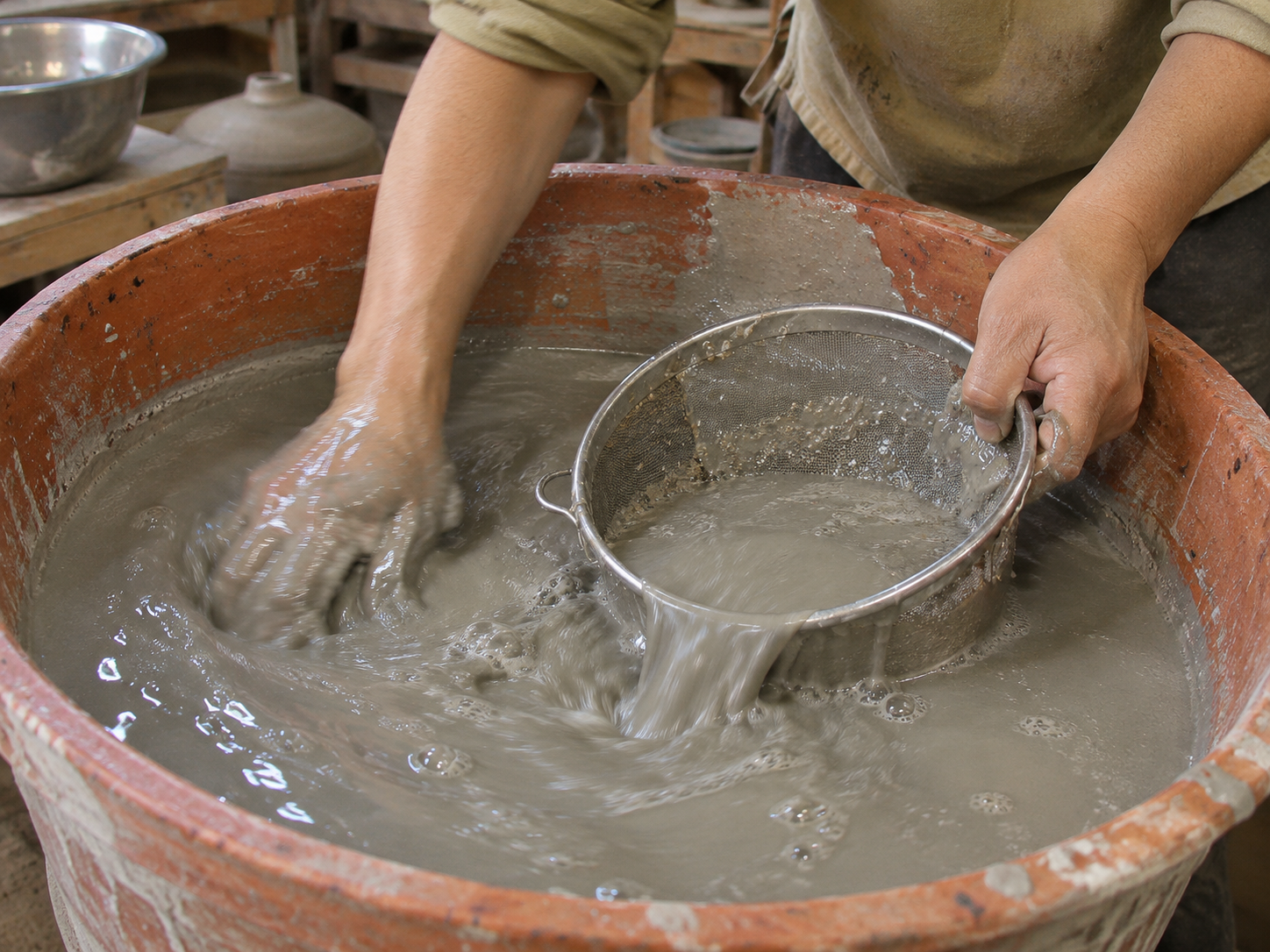
AI-generated image for illustrative purposes only.
Unlike a glaze formulated entirely from commercially refined materials, a traditional ash glaze may incorporate mineral substances obtained from burned wood. Different types of wood produce ashes with different chemical compositions.
The proportions of calcium, potassium, magnesium, phosphorus, silica, and other minerals vary depending on the species of tree, the growing environment, and the conditions under which the wood is burned. Even ash collected from the same type of wood can differ from one firing to another.
Furthermore, the preparation of traditional ash glaze varies from workshop to workshop. Each artisan may follow a distinctive recipe, using different combinations of materials, mixing ratios, and preparation techniques, often refined through years of experience and passed down through generations.
This variability creates both challenges and artistic possibilities, making each artisan's approach to ash glazing a distinctive expression of craftsmanship.
4. Inside the Kiln — When Minerals Begin to Melt
The true transformation of glaze occurs inside the kiln. As temperature rises, glaze ingredients undergo a sequence of changes. Some materials decompose and release gases. Others react with neighboring minerals and begin to form liquid phases.
As melting progresses, the glaze becomes a viscous liquid capable of spreading and bonding with the ceramic surface. The degree of melting depends on the glaze composition and the firing schedule. Many traditional Korean stoneware and porcelain traditions employ high-temperature firing, often within a broad range of approximately 1,200–1,300°C or higher, depending on the ware and technique. At these temperatures, suitably formulated glazes can become sufficiently fluid to develop a continuous glassy surface.
However, temperature alone does not determine the result. The kiln atmosphere is equally important. In an oxidation atmosphere, oxygen is relatively abundant. In a reduction atmosphere, the supply of oxygen is restricted relative to the combustion process. These conditions can change the chemical state of certain coloring elements, particularly iron. Consequently, the same glaze materials may produce noticeably different colors under different firing atmospheres.
The cooling stage also matters. As the molten glaze cools, it solidifies into glass, sometimes with the formation of microscopic or visible crystals. The cooling rate can influence crystallization, surface appearance, and the development of certain colors. Thus, the finished glaze reflects not only the ingredients applied to the vessel, but also the entire history of its firing.
The Language of the Glaze — Flow, Texture, and Crackle
Glaze gives Korean ceramics their distinctive colors, textures, and surface expressions. Its final appearance is shaped by the interaction of minerals, temperature, kiln atmosphere, and fire.
During firing, molten glaze may flow naturally across the surface, creating delicate variations in thickness and color. Some glazes develop a smooth, glossy finish, while others reveal soft matte textures or intricate crackle patterns known as crazing.
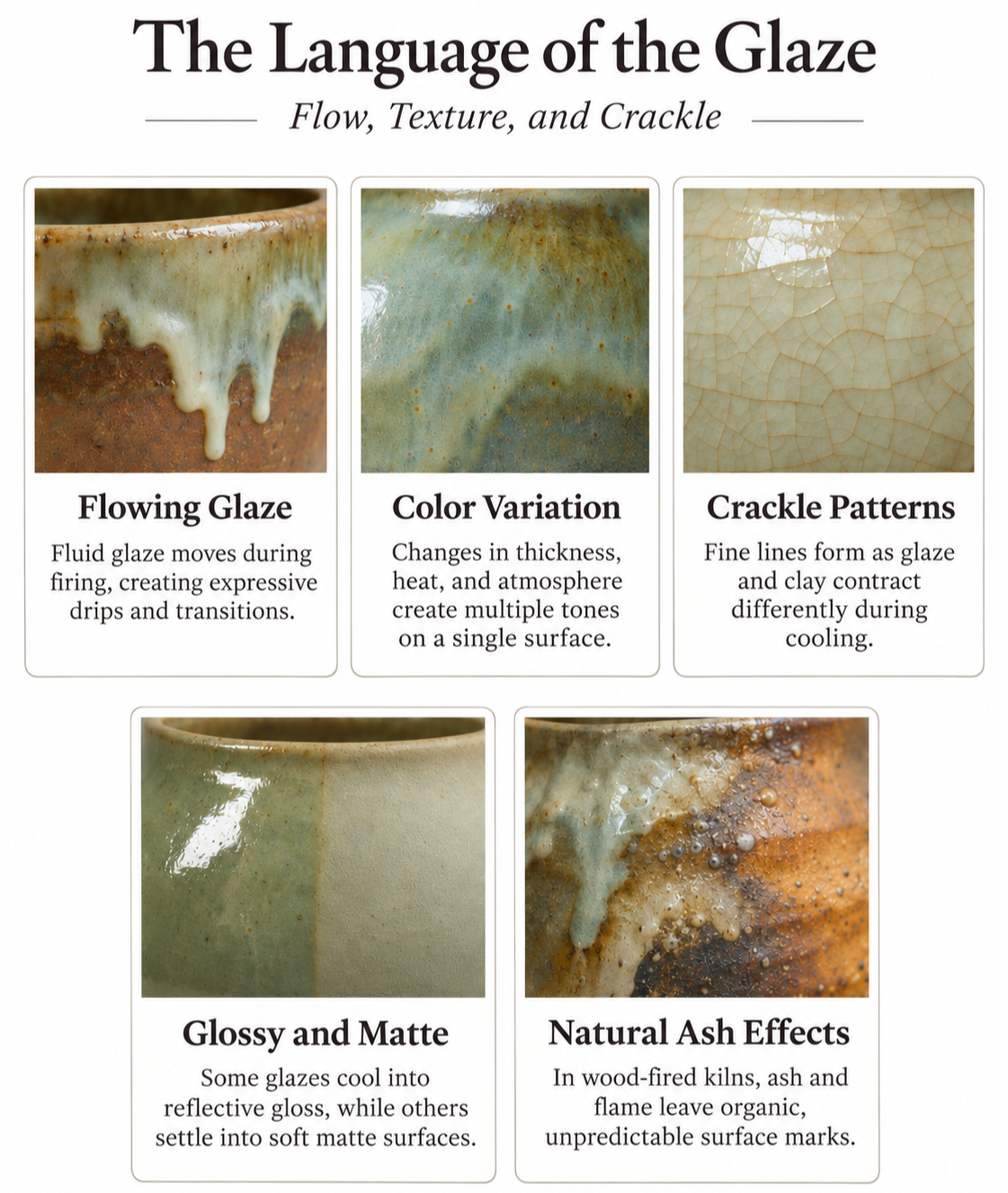
AI-generated image for illustrative purposes only.
In traditional wood-fired kilns, airborne ash and moving flames can produce unpredictable mineral deposits, flowing patterns, and subtle changes in color.
These effects make each firing unique, reflecting both the artisan's craftsmanship and the natural forces within the kiln.
The beauty of glaze lies not always in perfect uniformity, but in the subtle variations created through its transformation by fire.
Glaze as the Expression of an Artisan
Glaze is one of the clearest expressions of a ceramic artist’s identity, shaped by personal choices in materials, preparation, and firing. Even when using similar clay and kiln temperatures, different artisans can produce entirely different results—some seeking clear, luminous surfaces, others favoring thick ash glazes, earthy flows, or contrasts between glazed and unglazed areas.
In Korean traditional ceramics, glaze is not merely a decorative coating but a transformed material that reflects the artisan’s experience, the chemistry of minerals, and the effects of fire. Its color, texture, and movement all preserve the story of that transformation, revealing how generations of knowledge continue to find expression on the surface of each finished vessel.
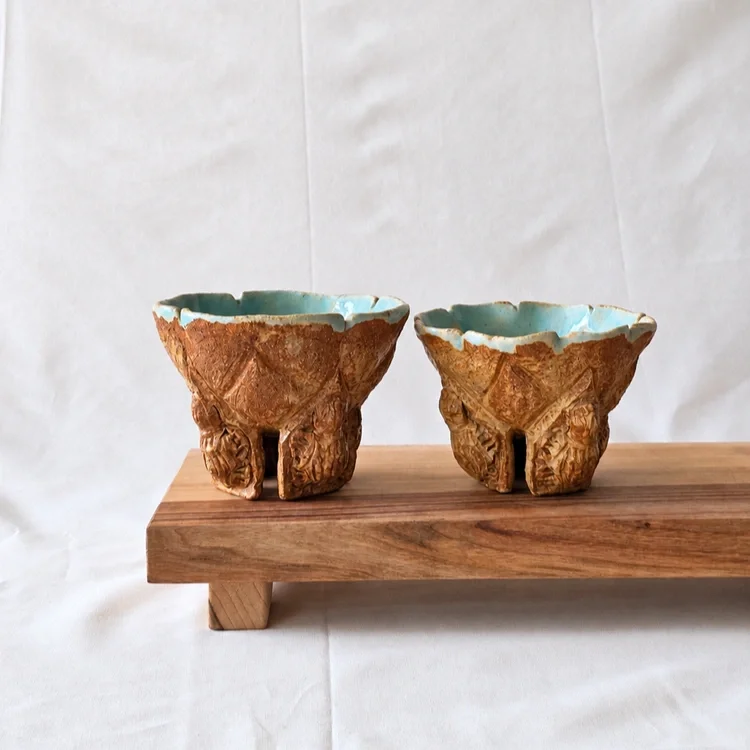
Tea bowls made by Daehui Jeong - Sangju
Earth gives the vessel its body. The artisan gives it form. Glaze and fire create its final surface.
And in that surface, centuries of Korean ceramic knowledge continue to find expression.
