
Eight Generations of Korean Onggi Craftsmanship
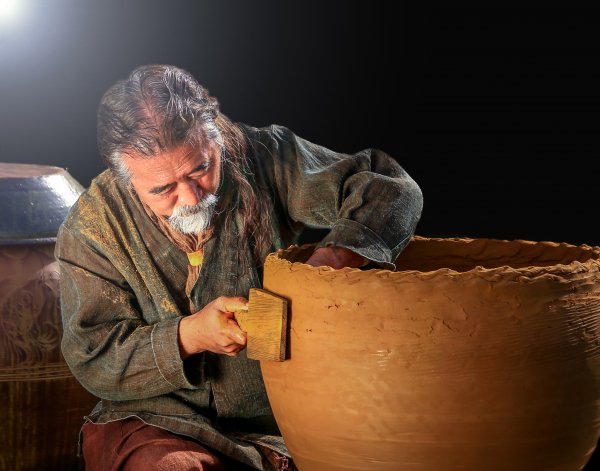
In the quiet countryside of Sangju, North Gyeongsang Province, a centuries-old craft continues to live through the hands of one family. Jeong Dae-hee, a master of traditional Korean onggi pottery, carries forward a legacy shaped by earth, fire, patience, and generations of accumulated knowledge.
Onggi are traditional Korean earthenware vessels, long used to store and ferment food such as kimchi, doenjang (fermented soybean paste), and gochujang (red chili paste). More than everyday containers, they embody a close relationship between Korean life and the natural materials that sustain it.
A Tradition Passed Down Through Generations
Jeong learned the craft from his father, Jeong Hak-bong, and has devoted more than four decades to making onggi. Under his care, the family's traditional techniques continue to be practiced and passed on to younger generations, preserving a craft that might otherwise become increasingly difficult to sustain.
In 2021, Jeong was officially recognized as the holder of the Sangju Onggi-jang tradition by Gyeongsangbuk-do, an acknowledgment of his skill and commitment to safeguarding this regional craft.
The significance of his work lies not only in the vessels he produces, but also in the knowledge embedded in their making. Each generation inherits more than a set of techniques: it receives an understanding of clay, the demands of the kiln, and the patience required to work with materials whose final form can never be entirely separated from the natural process of firing.
Shaped by Earth and Fire
Traditional onggi-making requires an intimate understanding of clay and the transformation it undergoes in the kiln. The potter shapes the vessel by hand, working with the material's consistency and character before entrusting it to the intense heat of the firing process.
The result is never simply a manufactured object. Subtle variations in form, surface, and colour reflect the interaction between the maker, the clay, and the fire.
For Jeong, maintaining traditional production methods is an essential part of preserving the identity of Sangju onggi. His practice reminds us that craftsmanship is not merely about reproducing an object's appearance; it is about sustaining the knowledge and processes that give the object its meaning.
Keeping a Living Heritage
The story of Jeong Dae-hee is ultimately a story of continuity. In an age when objects can be produced in vast quantities, his work preserves a slower and more intimate relationship between the maker and the things people use in their daily lives.
An onggi vessel carries traces of the earth from which it was formed and the fire through which it was transformed. It also carries the accumulated knowledge of those who made it, connecting the present with generations of practice.
Through his dedication to traditional craftsmanship, Jeong reminds us that heritage is not something preserved only in museums or historical records. It remains alive whenever knowledge is practiced, shared, and passed on.
Discover the traditional craftsmanship of Jeong Dae-hee and explore his work at Sogeum Gallery, where Korean ceramic traditions meet contemporary appreciation for art and craft.
Sources and further reading
National Culture Portal, Between Tradition and Art: The Two Paths of Onggi Master Jeong Dae-hee
Gyeongbuk Maeil, Onggi Master Jeong Dae-hee Donates 50 Ho-sabals to Sangju Museum (2022)
Gyeongbuk Maeil, Jeong Dae-hee Recognized as Holder of the Sangju Onggi-jang Tradition (2021)
By Master Artisan Daehui Jeong
Six Generations of Craftsmanship · Nearly 300 Years of Tradition
Meet the Artisan →
The Artwork
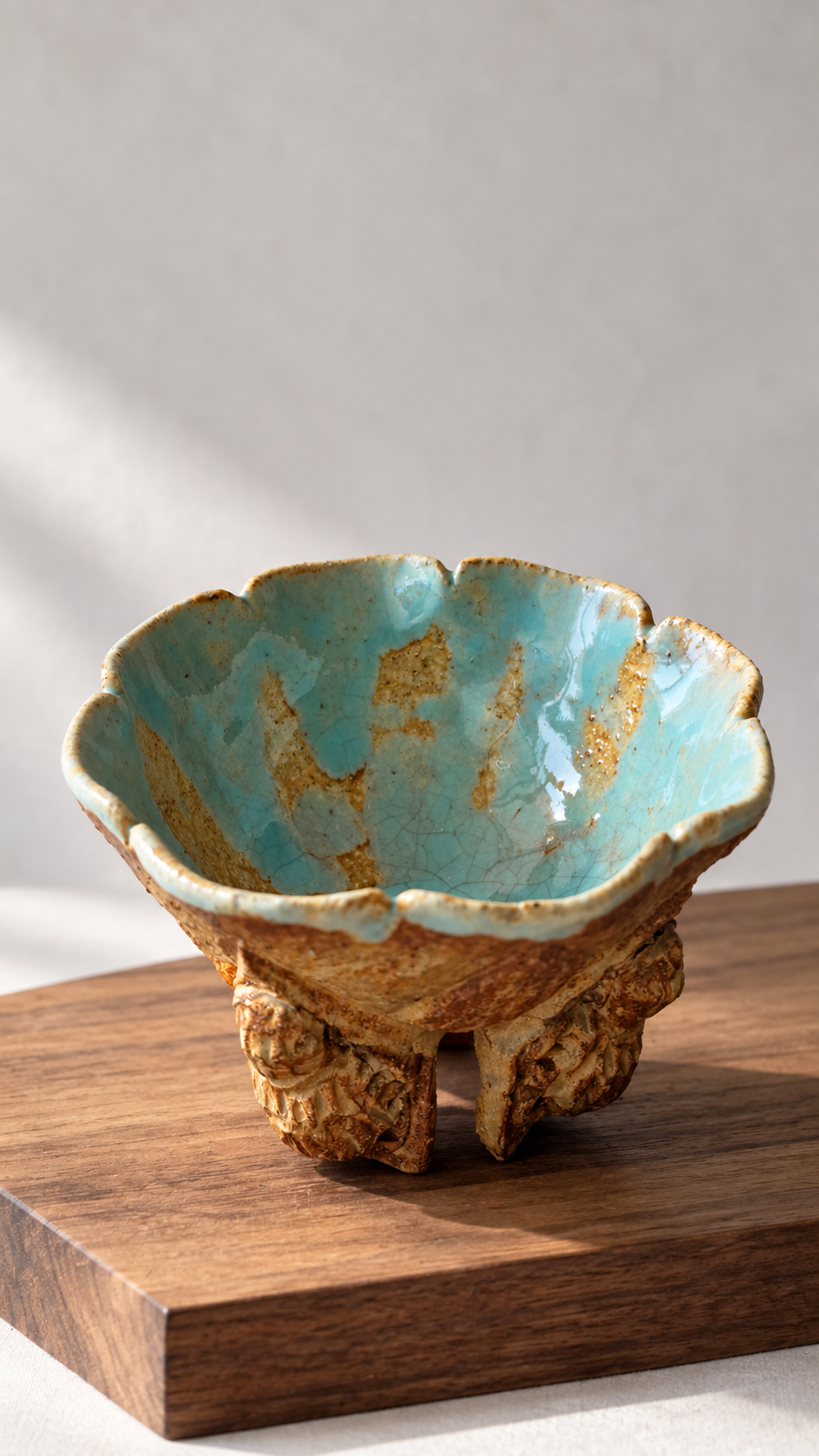
Handcrafted by Korean master artisan Daehui Jeong, this sculptural tea bowl brings together the natural beauty of earth and fire.
Its gently curved rim opens like flower petals, revealing a luminous turquoise interior with delicate crackle patterns and earthy golden-brown markings.
The rugged exterior and intricately sculpted base create a striking contrast between refined elegance and the raw character of clay.
Six Generations of Tradition
Daehui Jeong is a sixth-generation master artisan from Sangju, South Korea, whose family has preserved traditional pottery-making techniques for nearly 300 years.
Trained by his father, the late master Hakbong Jeong (1930–2018), he has dedicated more than four decades to the craft.
In 2021, he was officially recognized as a holder of Sangju Onggi-making, Gyeongsangbuk-do Intangible Cultural Heritage No. 25-da.
Traditional Pine-Ash Glazing
One of the distinguishing features of Master Jeong's traditional pottery practice is his use of a natural glaze prepared from pinewood ash. Pinewood ash is mixed with clean water, then aged and refined to produce a fine glaze. This traditional preparation method has been passed down through his family for generations.
Rather than relying solely on industrially prepared glazes, his practice preserves an inherited understanding of natural materials and their behavior in the kiln.
The Art of Wood Firing
Master Jeong's traditional pottery undergoes an exceptionally demanding firing process.
Pieces may be slowly dried for approximately three months before firing in a traditional six-chamber wood-fired kiln.
Pinewood fires were maintained for eight days and seven nights, reaching temperatures of approximately 1,250–1,350°C.
No two days bring exactly the same fire.
The flames, temperature, and airflow continuously change, leaving subtle variations in color and texture.
The results depend not only on the artisan's skill but also on the unpredictable nature of fire.
These qualities are part of what makes traditional wood-fired ceramics so distinctive.
This particular bowl remained inside the kiln for approximately two weeks.
Product Details
Artist: Daehui Jeong
Origin: Sangju, South Korea
Dimensions: 11.5 cm (W) × 11.5 cm (D) × 8.5 cm (H)
Weight: 328 g
Capacity: 240 mL
Care Instructions
Do not use a dishwasher.
Do not use detergents or chemical cleaning agents.
Gently rinse with hot water after use.
Wipe with a soft cloth and allow to dry completely.
Avoid sudden temperature changes and strong impacts.
Natural variations in color, surface texture, and glaze are characteristic of handcrafted ceramics.
International Shipping & Import Duties
All artworks are carefully packed and shipped directly from South Korea.
Please allow about one week for us to prepare your order. All orders are shipped by air, and we will do our best to get your artwork to you as quickly as possible. Delivery times may vary depending on your country and local shipping conditions.
We offer free worldwide shipping on all orders, no matter where you are.
Please note that your order may be subject to import duties, taxes, or customs fees, depending on the rules in your country. These charges are not included in the artwork price. If they apply, they are charged by local customs and usually collected by the shipping company. Any import charges must be paid by the customer.
We recommend checking your country's import rules before placing an order.
By Master Artisan Daehui Jeong
Six Generations of Craftsmanship · Nearly 300 Years of Tradition
Meet the Artisan →
The Artwork
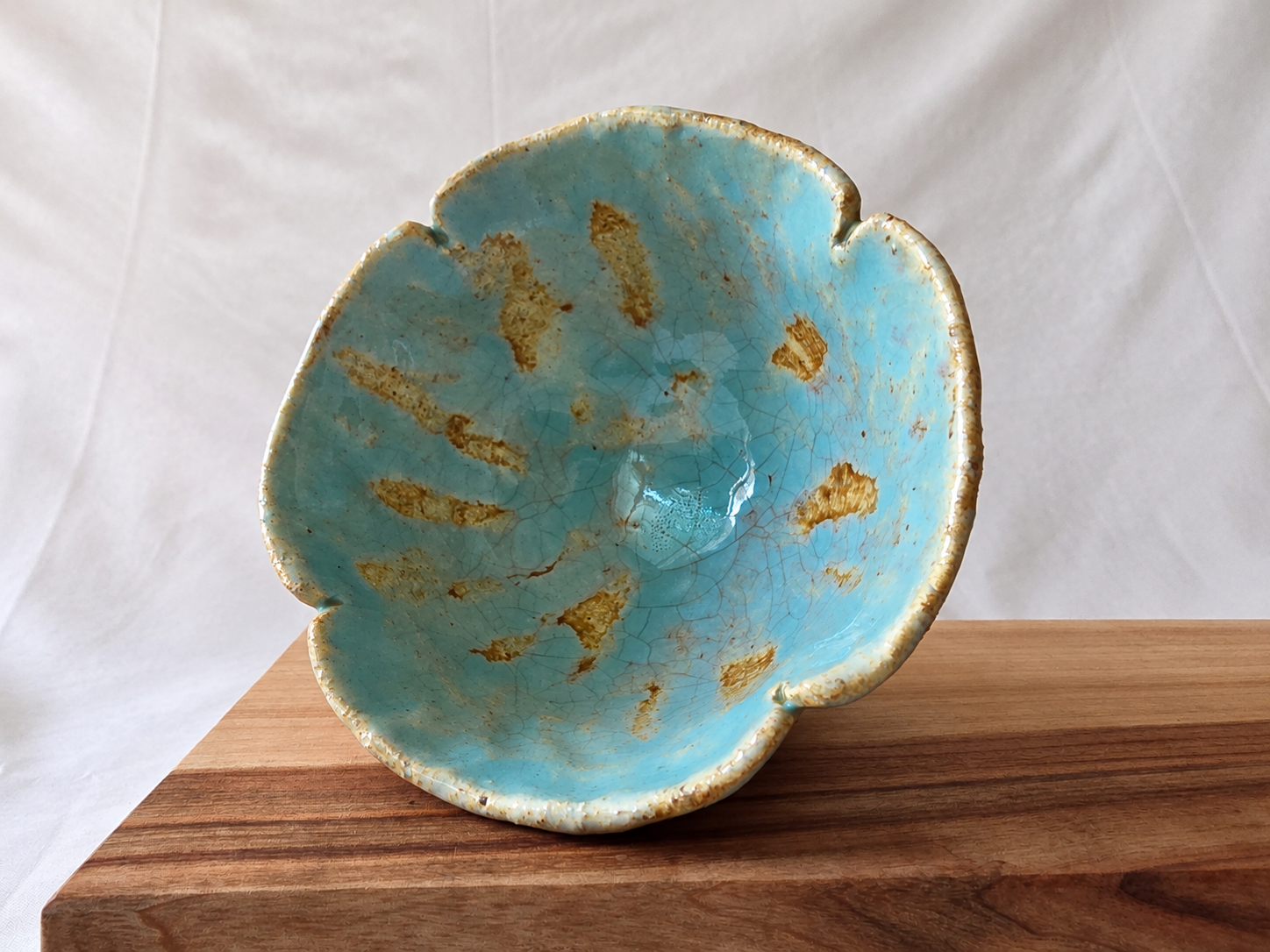
Handcrafted by Korean master artisan Daehui Jeong, this sculptural tea bowl brings together the natural beauty of earth and fire.
Its gently curved rim opens like flower petals, revealing a luminous turquoise interior with delicate crackle patterns and earthy golden-brown markings.
The rugged exterior and intricately sculpted base create a striking contrast between refined elegance and the raw character of clay.
Six Generations of Tradition
Daehui Jeong is a sixth-generation master artisan from Sangju, South Korea, whose family has preserved traditional pottery-making techniques for nearly 300 years.
Trained by his father, the late master Hakbong Jeong (1930–2018), he has dedicated more than four decades to the craft.
In 2021, he was officially recognized as a holder of Sangju Onggi-making, Gyeongsangbuk-do Intangible Cultural Heritage No. 25-da.
Traditional Pine-Ash Glazing
One of the distinguishing features of Master Jeong's traditional pottery practice is his use of a natural glaze prepared from pinewood ash. This traditional preparation method has been passed down through his family for generations.
Rather than relying solely on industrially prepared glazes, his practice preserves an inherited understanding of natural materials and their behavior in the kiln.
The Art of Wood Firing
Master Jeong's traditional pottery undergoes an exceptionally demanding firing process.
Pieces may be slowly dried for approximately three months before firing in a traditional six-chamber wood-fired kiln.
Pinewood fires were maintained for eight days and seven nights, reaching temperatures of approximately 1,250–1,350°C.
No two days bring exactly the same fire.
The flames, temperature, and airflow continuously change, leaving subtle variations in color and texture.
The results depend not only on the artisan's skill but also on the unpredictable nature of fire.
These qualities are part of what makes traditional wood-fired ceramics so distinctive.
This particular bowl remained inside the kiln for approximately two weeks.
Product Details
Artist: Daehui Jeong
Origin: Sangju, South Korea
Dimensions: 12 cm (W) × 12 cm (D) × 9 cm (H)
Weight: 351.7 g
Capacity: 332 mL
Care Instructions
Do not use a dishwasher.
Do not use detergents or chemical cleaning agents.
Gently rinse with hot water after use.
Wipe with a soft cloth and allow to dry completely.
Avoid sudden temperature changes and strong impacts.
Natural variations in color, surface texture, and glaze are characteristic of handcrafted ceramics.
International Shipping & Import Duties
All artworks are carefully packed and shipped directly from South Korea.
Please allow about one week for us to prepare your order. All orders are shipped by air, and we will do our best to get your artwork to you as quickly as possible. Delivery times may vary depending on your country and local shipping conditions.
We offer free worldwide shipping on all orders, no matter where you are.
Please note that your order may be subject to import duties, taxes, or customs fees, depending on the rules in your country. These charges are not included in the artwork price. If they apply, they are charged by local customs and usually collected by the shipping company. Any import charges must be paid by the customer.
We recommend checking your country's import rules before placing an order.
By Master Artisan Daehui Jeong
Six Generations of Craftsmanship · Nearly 300 Years of Tradition
Meet the Artisan →
The Artwork
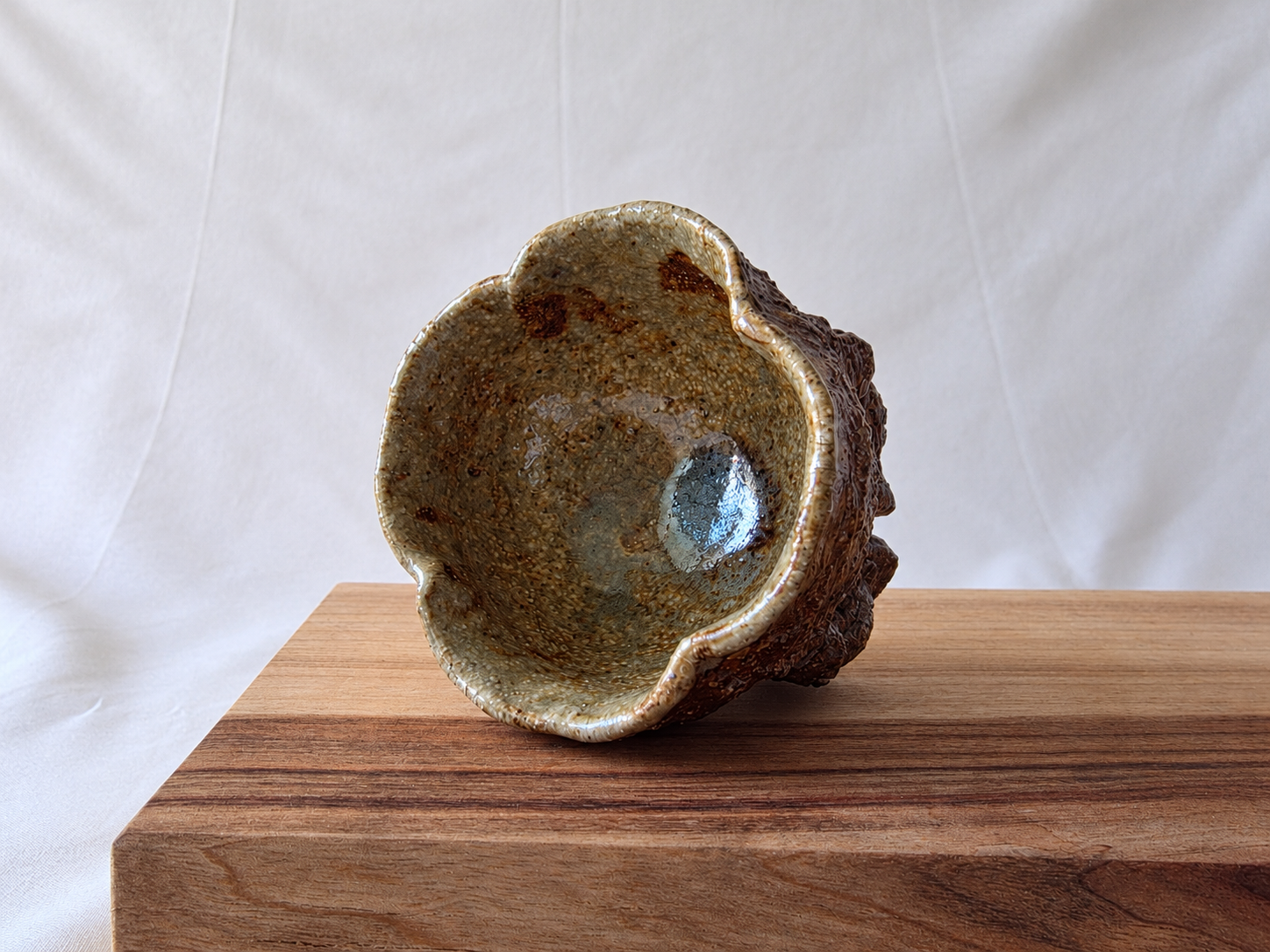
Handcrafted by Korean master artisan Daehui Jeong, this sculptural tea bowl captures the organic beauty of nature through the interplay of earth, glaze, and fire.
Its irregular, flower-like rim unfolds in gentle curves, revealing a richly textured interior where muted olive-green, warm amber, and earthy brown tones blend naturally beneath a glossy glaze.
Subtle speckles, delicate surface patterns, and variations in color give the interior a remarkable sense of depth.
The rugged, deeply textured exterior resembles weathered tree bark, creating a striking contrast with the smooth, glazed interior.
Every curve and surface bears the character of hand craftsmanship, making this bowl a distinctive work of ceramic art.
When filled with warm water and gently cradled in both hands, the bowl offers a comforting warmth that seems to spread throughout the entire body, inviting a quiet moment of peace and stillness.
Six Generations of Tradition
Daehui Jeong is a sixth-generation master artisan from Sangju, South Korea, whose family has preserved traditional pottery-making techniques for nearly 300 years.
Trained by his father, the late master Hakbong Jeong (1930–2018), he has dedicated more than four decades to the craft.
In 2021, he was officially recognized as a holder of Sangju Onggi-making, Gyeongsangbuk-do Intangible Cultural Heritage No. 25-da.
Traditional Pine-Ash Glazing
One of the distinguishing features of Master Jeong's traditional pottery practice is his use of a natural glaze prepared from pinewood ash. This traditional preparation method has been passed down through his family for generations.
Rather than relying solely on industrially prepared glazes, his practice preserves an inherited understanding of natural materials and their behavior in the kiln.
The Art of Wood Firing
Master Jeong's traditional pottery undergoes an exceptionally demanding firing process.
Pieces may be slowly dried for approximately three months before firing in a traditional six-chamber wood-fired kiln.
In his traditional firing practice, pinewood fires may be maintained for eight days and seven nights, reaching temperatures of approximately 1,250–1,350°C.
No two days bring exactly the same fire.
The flames, temperature, and airflow continuously change, leaving subtle variations in color and texture.
The results depend not only on the artisan's skill but also on the unpredictable nature of fire.
These qualities are part of what makes traditional wood-fired ceramics so distinctive.
This particular bowl remained inside the kiln for approximately three weeks.
Product Details
Artist: Daehui Jeong
Origin: Sangju, South Korea
Dimensions: 8.5cm (W) × 8.5cm (D) × 10cm (H)
Weight: 240 g
Capacity: 125 mL
Care Instructions
Do not use a dishwasher.
Do not use detergents or chemical cleaning agents.
Gently rinse with hot water after use.
Wipe with a soft cloth and allow to dry completely.
Avoid sudden temperature changes and strong impacts.
Natural variations in color, surface texture, and glaze are characteristic of handcrafted ceramics.
International Shipping & Import Duties
All artworks are carefully packed and shipped directly from South Korea.
Please allow about one week for us to prepare your order. All orders are shipped by air, and we will do our best to get your artwork to you as quickly as possible. Delivery times may vary depending on your country and local shipping conditions.
We offer free worldwide shipping on all orders, no matter where you are.
Please note that your order may be subject to import duties, taxes, or customs fees, depending on the rules in your country. These charges are not included in the artwork price. If they apply, they are charged by local customs and usually collected by the shipping company. Any import charges must be paid by the customer.
We recommend checking your country's import rules before placing an order.
