
Eight Generations of Korean Ceramic Heritage
In Mungyeong, North Gyeongsang Province, a remarkable ceramic tradition spanning approximately 240 years continues through the hands of Yunsik Kim (김윤식), known by his artistic name Songsan (송산).
As the eighth-generation successor to Gyeongbukyo (경북요), Kim inherits a family legacy dating back to the Joseon Dynasty. His ancestors were sagijang (사기장), traditional porcelain craftsmen who produced ceramics for the royal court.
According to the family's historical account, porcelain created by his ancestors was used by the Joseon royal household, and examples of their ceramic work are preserved in the collections of the Kyujanggak Institute for Korean Studies at Seoul National University.
This heritage connects Gyeongbukyo to Korea's royal porcelain traditions and generations of craftsmanship passed down through the centuries.
A Legacy Passed Down Through Eight Generations
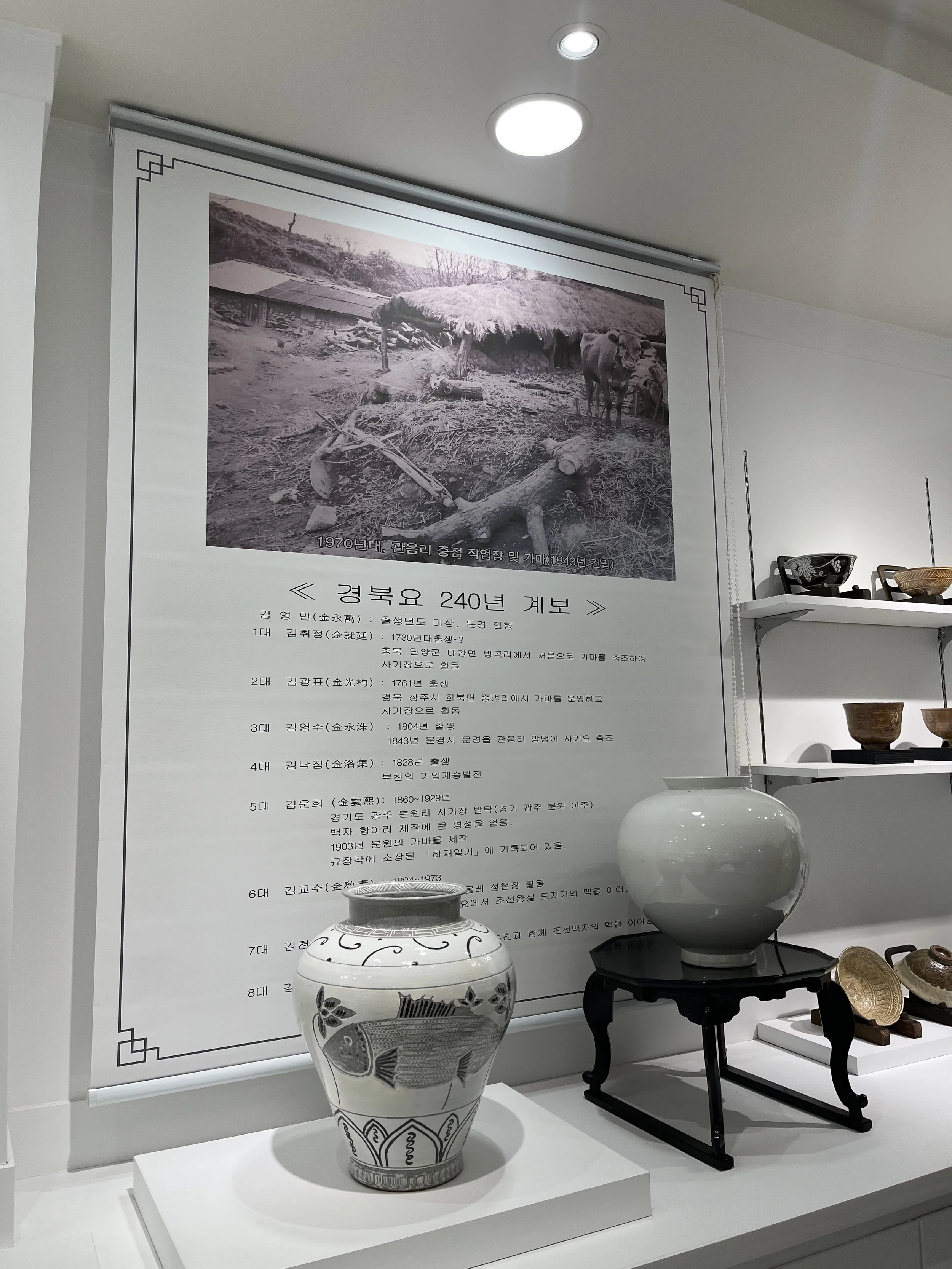
The history of Gyeongbukyo is preserved through a family genealogy documenting the lives and craftsmanship of eight generations of potters.
1st Generation — Kim Chwi-jeong (김취정, born in the 1730s)
Established an early kiln in Banggok-ri, Danyang, laying the foundations of the family's pottery-making tradition.2nd Generation — Kim Gwang-pyo (김광표, born 1761)
Continued the family craft, operating a kiln in Jungbeol-ri, Sangju.3rd Generation — Kim Yeong-su (김영수, born 1804)
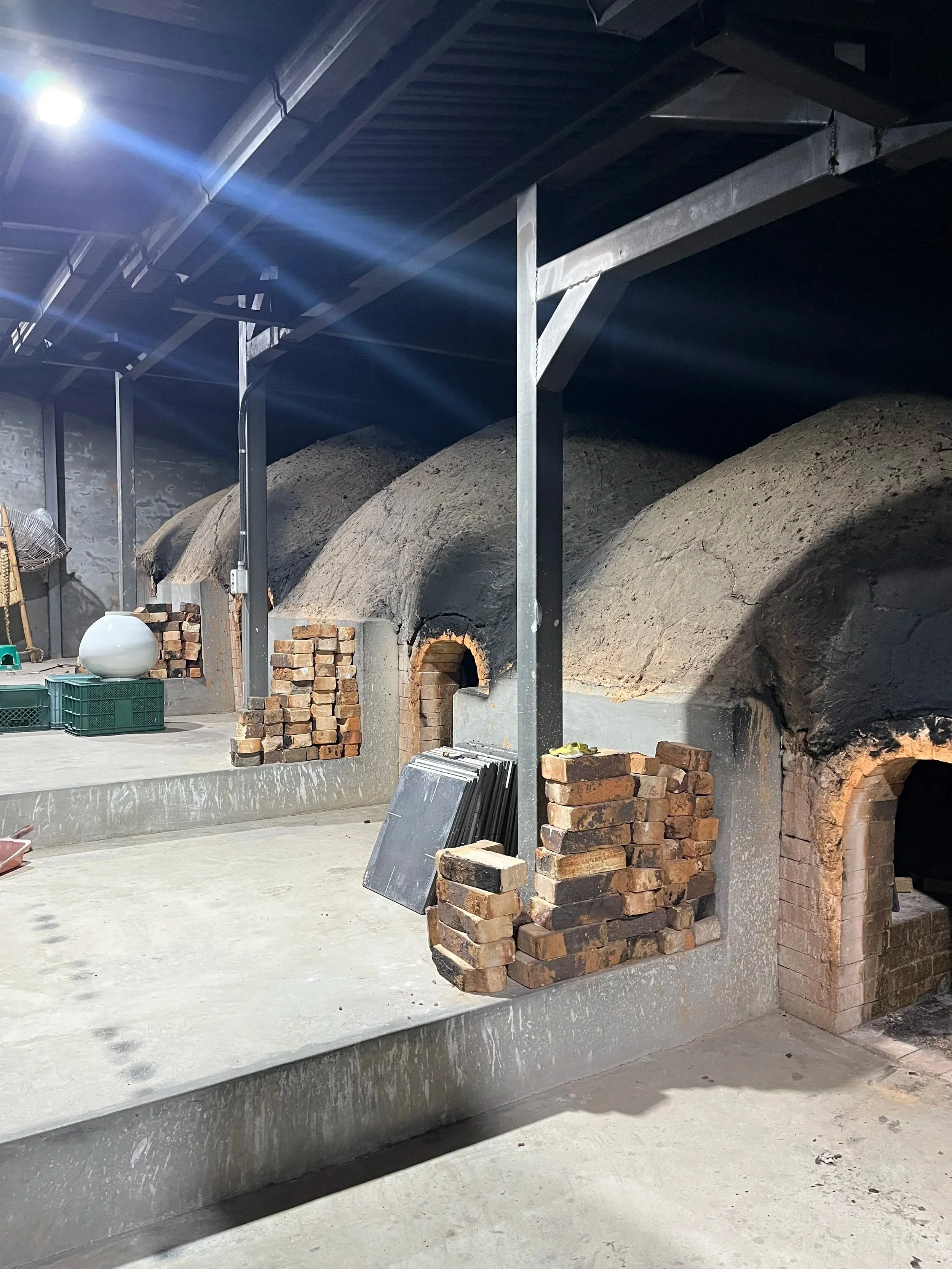
Established a kiln in Gwaneum-ri, Mungyeong, in 1843, strengthening the family's connection to the region.4th Generation — Kim Nak-jip (김낙집, born 1828)
Inherited and developed the pottery-making traditions of his ancestors.5th Generation — Kim Un-hui (김운희, 1860–1929)
Worked in Bunwon-ri, Gwangju, the historic center of royal porcelain production during the Joseon Dynasty.
He participated in the production of porcelain for the royal household and specialized in traditional white porcelain vessels. Family records also document kiln construction in 1903.6th Generation — Kim Gyo-su (김교수, 1894–1973)
Worked alongside his father in Bunwon, continuing the family's involvement in royal porcelain production.
After returning to Mungyeong in 1917, he became an influential figure in the local pottery community, preserving traditional white porcelain techniques and passing his knowledge to later generations.7th Generation — Kim Cheon-man (김천만)
Continued the family's ceramic craftsmanship, preserving techniques and knowledge inherited from previous generations.8th Generation — Yunsik Kim (김윤식)
The present-day successor of Gyeongbukyo, carrying forward the family's centuries-old ceramic heritage while developing his own artistic expression.
From Royal Porcelain to the Ceramic Heritage of Mungyeong
During the Joseon Dynasty, Bunwon in Gwangju served as the principal center for producing porcelain for the royal court.
The involvement of Kim's ancestors in this historic center forms an important chapter in the family's history.
Their craftsmanship belonged to a tradition in which porcelain was valued for its refined forms, restrained elegance, and technical excellence.
Mungyeong, where the family later continued its work, is also renowned for its traditional ceramics and tea bowls, known as sabal (사발).
Through generations of craftsmanship, Gyeongbukyo's history connects the royal porcelain traditions of Joseon with the continuing ceramic culture of Mungyeong.
Tradition and Artistic Recognition
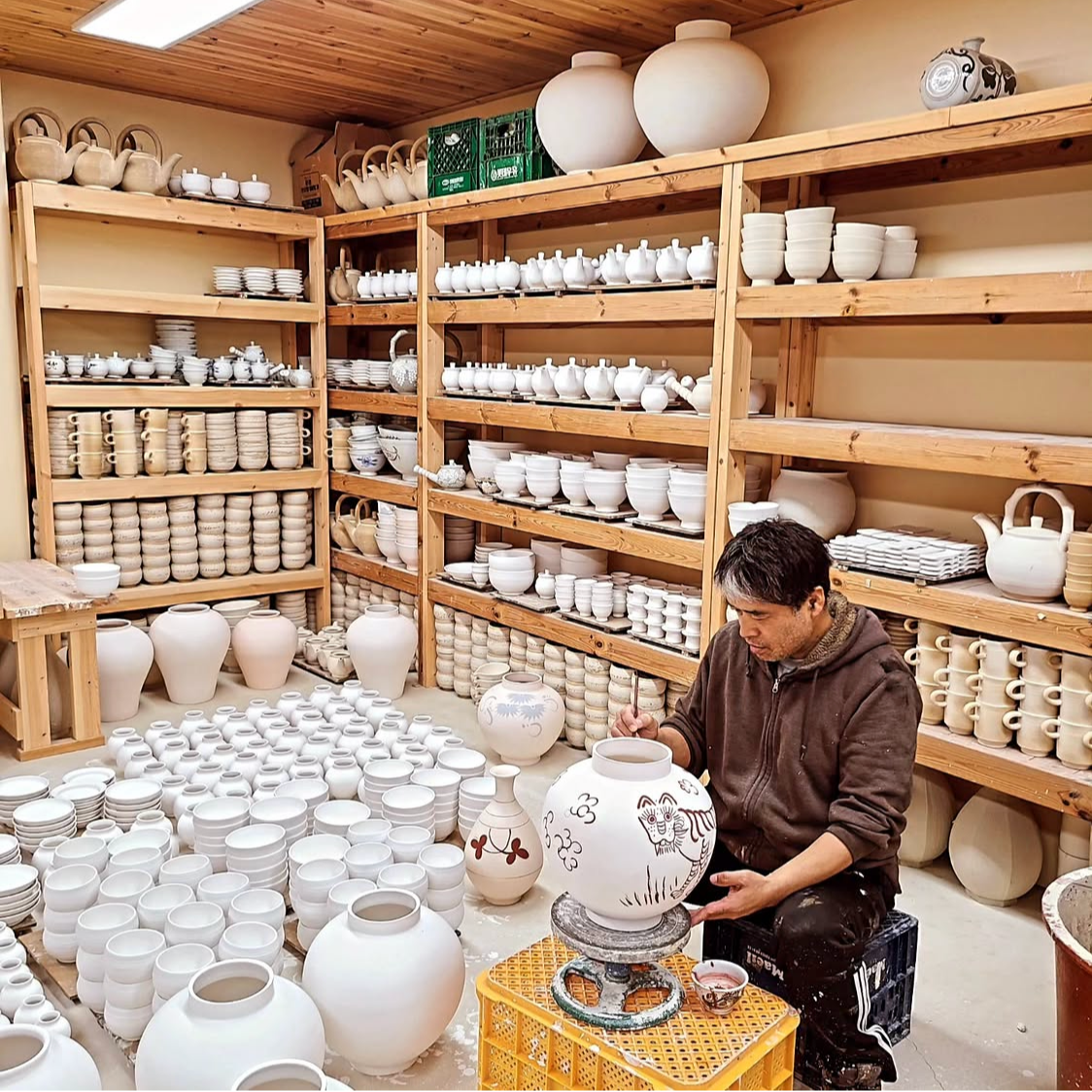
Yunsik Kim began his ceramic career in 1996, building upon the knowledge and craftsmanship inherited from his ancestors.
He remains one of the few artisans dedicated to using the traditional Korean foot-powered pottery wheel (balmulle) rather than a modern electric wheel, preserving the hands-on techniques passed down through generations of his family.
His dedication to Korean ceramics has earned recognition through numerous national craft competitions, with 29 awards or distinctions reported by 2026.
In 2025, the Korea Heritage Service acquired his work Buncheong Ware Iron-Painted Turtle-Shaped Bottle (분청사기 철화자라병), marking a notable achievement in his artistic career.
At Gyeongbukyo, Kim continues to explore traditional ceramic forms while developing his individual artistic vision, bringing inherited craftsmanship into contemporary Korean ceramic art.
Preserving a Living Heritage
For Yunsik Kim, ceramics represent more than artistic objects. They embody the accumulated knowledge, dedication, and cultural memory of eight generations of craftsmen.
From porcelain produced for the Joseon royal court to the contemporary works of Gyeongbukyo, his family's history reflects an enduring relationship with clay, fire, and traditional Korean artistry.
Through his work, Kim continues this remarkable legacy, preserving the craftsmanship of his ancestors while contributing his own artistic vision to the future of Korean ceramics.
Discover the works of Yunsik Kim at Sogeum Gallery, where centuries of Korean ceramic heritage continue through the hands of today's artisans.
Sources and Further Reading
Gyeongbukyo, 240-Year Family Genealogy — Historical lineage and kiln records displayed at the studio.
Mungyeong City Tourism — Historical information concerning Kim Gyo-su and the family's ceramic tradition.
Seoul National University, Kyujanggak Institute for Korean Studies — Collection attribution reported in the Gyeongbukyo family account; individual objects pending verification.
Regional news coverage (2025–2026) — Historical accounts of the family's royal porcelain production and Yunsik Kim's artistic achievements.
By Master Artisan Yunsik Kim
Eight Generations of Craftsmanship · Nearly 240 Years of Tradition
Meet the Artisan →
The Artwork
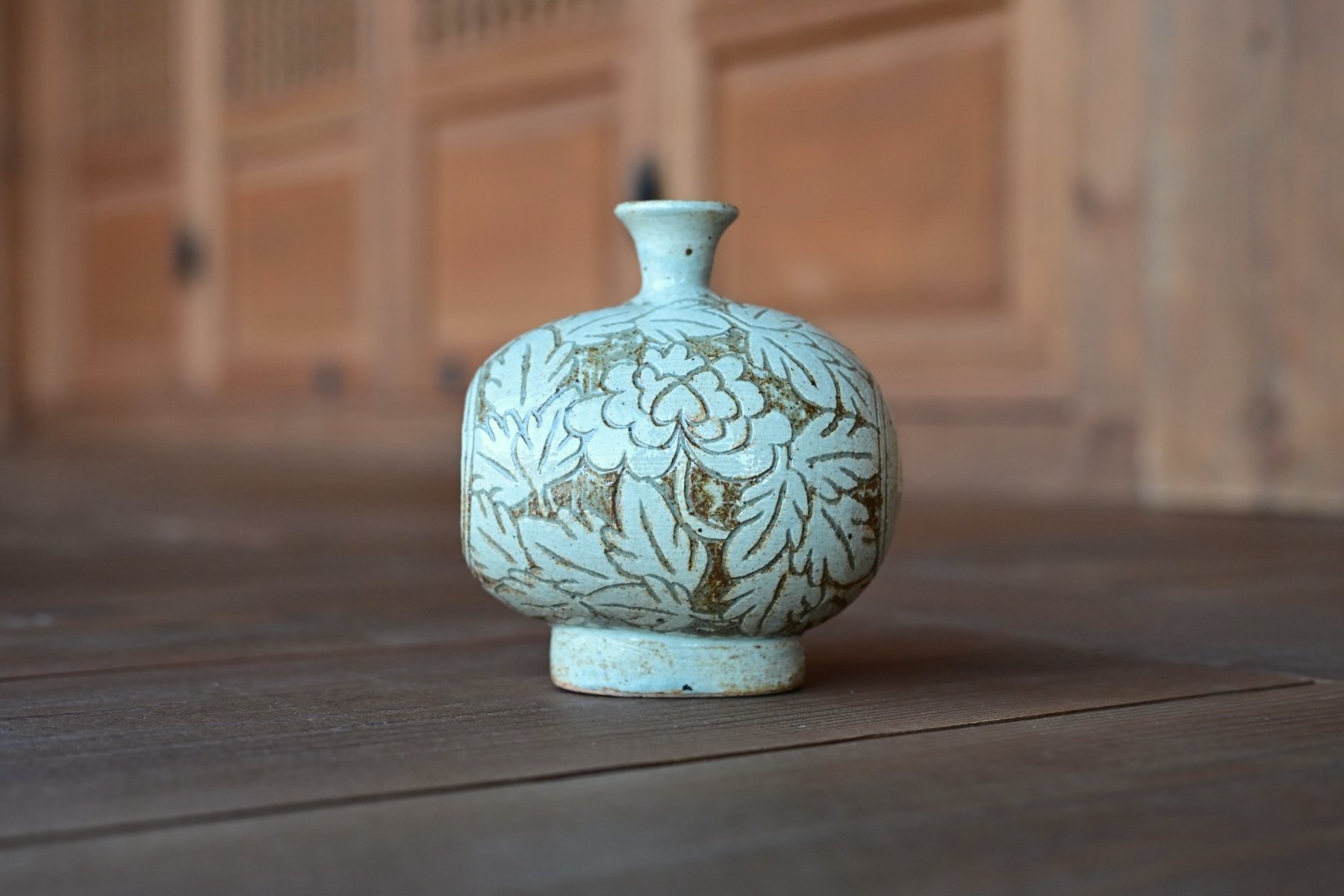
Created by Korean ceramic artist Yunsik Kim, this vase carries forward the buncheong tradition of the Joseon dynasty through a family pottery heritage spanning eight generations. Working with a traditional foot-powered wheel and time-honored methods, Kim continues this living craft through his own hands.
The vase pairs a softly rounded, flattened body with a slender neck and gently flared mouth. A compact foot provides a balanced foundation, giving the piece a quiet sculptural presence.
Peony blossoms and sweeping leaves extend across the surface, their pale blue-green forms outlined by earthy brown tones. The floral decoration follows the vessel’s curves, revealing a different composition from each viewpoint, while circular panels on either side offer a restful contrast.
Subtle glaze variations, scattered speckles, and softly irregular contours reveal the character of the materials and the artisan’s touch. Completed by a small maker’s seal near the foot, the piece embodies a tradition sustained and practiced across generations.
Product Details
Artist: Yunsik Kim
Origin: Mungyeong, South Korea
Dimensions: 12cm (W) × 10cm (D) × 14cm (H)
Weight: 408g
Care Instructions
Do not use detergents or chemical cleaning agents.
Avoid sudden temperature changes and strong impacts.
Natural variations in color, surface texture, and glaze are characteristic of handcrafted ceramics.
International Shipping & Import Duties
All artworks are carefully packed and shipped directly from South Korea.
Please allow about one week for us to prepare your order. All orders are shipped by air, and we will do our best to get your artwork to you as quickly as possible. Delivery times may vary depending on your country and local shipping conditions.
We offer free worldwide shipping on all orders, no matter where you are.
Please note that your order may be subject to import duties, taxes, or customs fees, depending on the rules in your country. These charges are not included in the artwork price. If they apply, they are charged by local customs and usually collected by the shipping company. Any import charges must be paid by the customer.
We recommend checking your country's import rules before placing an order.
